
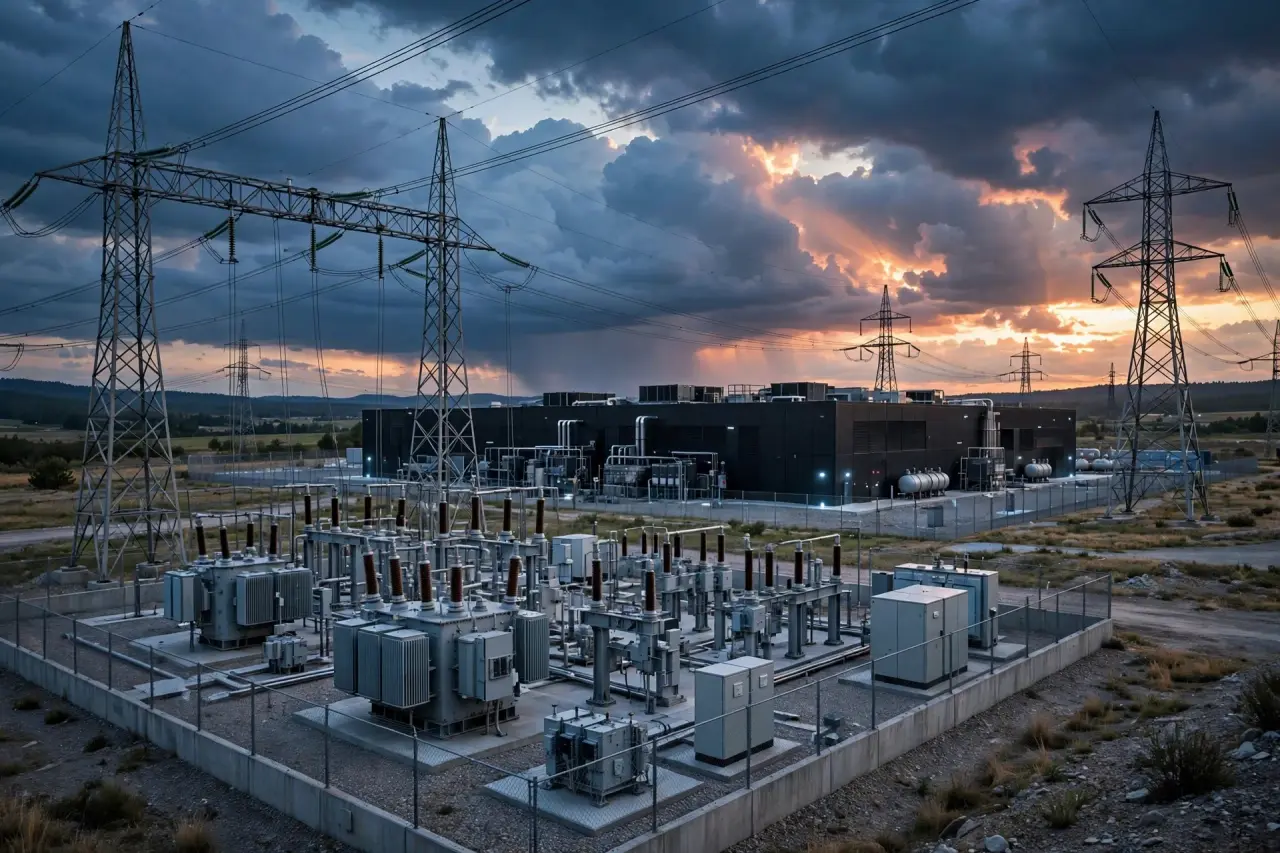
Most people picture a data center as a campus the size of a small town. The ones we build are not that. Our data centers run from 1 to 50 MW, and the smaller ones fit on a few acres, or inside a building that already exists. That changes who can be part of it. If you own a parcel or a building in the right place, you may hold something a developer needs, and you may never have thought of it that way.
This post explains how a deal with a developer like us works, what the landowner gets out of it, and where the limits are.
What makes a property useful
Four things matter more than anything else.
- Power close by. A substation or a transmission line near the property. This is the hardest thing to find and the first thing we look at.
- Fiber close by. More than one route, from more than one carrier.
- The land itself. Outside the flood plain, with road access, and zoning that can work.
- Enough room. A few acres is enough. A large tract is not required.
Existing buildings count too. A former telecom building, a warehouse, or a light industrial site that already has heavy electrical service can be a better starting point than open land, because the power and the fiber are already there.
You do not need to know the answers to all of this before you call. Working them out is the developer’s job.
How a deal works
It usually runs in four stages.
- A first conversation. You tell us where the property is, how big it is, and what is on it. We look at it on a desktop review. This costs you nothing and commits you to nothing.
- An option or a letter of intent. If the property looks promising, the developer asks for the right to buy or lease it within a set period. During that period the developer studies the power, the fiber, and the zoning. You still own the property, and you can normally keep using it as you do today.
- Diligence. The developer does the work and carries the cost of it: the conversations with the utility, the engineering, the title and survey work, the zoning. If the studies take longer than planned, the option is extended, and that extension is paid for.
- A purchase or a long lease. If the property passes, the developer buys it or leases it for the long term, and builds.
What the landowner gets
- Value from a property that may be sitting idle. A parcel next to a substation is often land nobody else wanted.
- A serious buyer or tenant. Data centers are built to run for decades, so the developer is planning for the long term.
- Someone else doing the work. You are not asked to study the grid, hire engineers, or apply for zoning. The developer does that.
- A quiet use. A small data center has few staff and little traffic once it is built.
The honest limits
Not every property works, and most do not. A site can look right and still fail on power, on fiber, on flood risk, or on zoning. When a site fails our screen, we say so, and we say why.
An option also ties up your property for a period. That is the point of it, but you should understand the length, the terms, and what happens if the developer walks away.
A data center has equipment that makes noise: cooling units, and backup generators that are tested on a schedule. Ask what will be on your site and where.
And get your own lawyer. A good developer will expect you to.
What to ask any developer
- How long is the option, and what do you pay for it?
- Who pays for the studies?
- What happens to my property if you do not go ahead?
- Do you want to buy or to lease?
- What will be built here, how big, and how loud?
- Who is the person I am dealing with, and can I call them?
If a developer cannot answer these plainly, keep looking.
If you have a property
Tell us about it. Where it is, how many acres, what is on it, and the nearest substation if you know it. We treat what you send us in confidence, and we reply within one business day.
Related reading: How we screen a site: the criteria that matter.