
There are three main ways to buy data center capacity, and they are not interchangeable. Build-to-suit, colocation, and powered shell differ on who builds, who owns the plant, who operates, and how long you commit. The right choice depends on the workload, the size, and how long you expect to run it. For AI inference, the answer is usually narrower than people think.
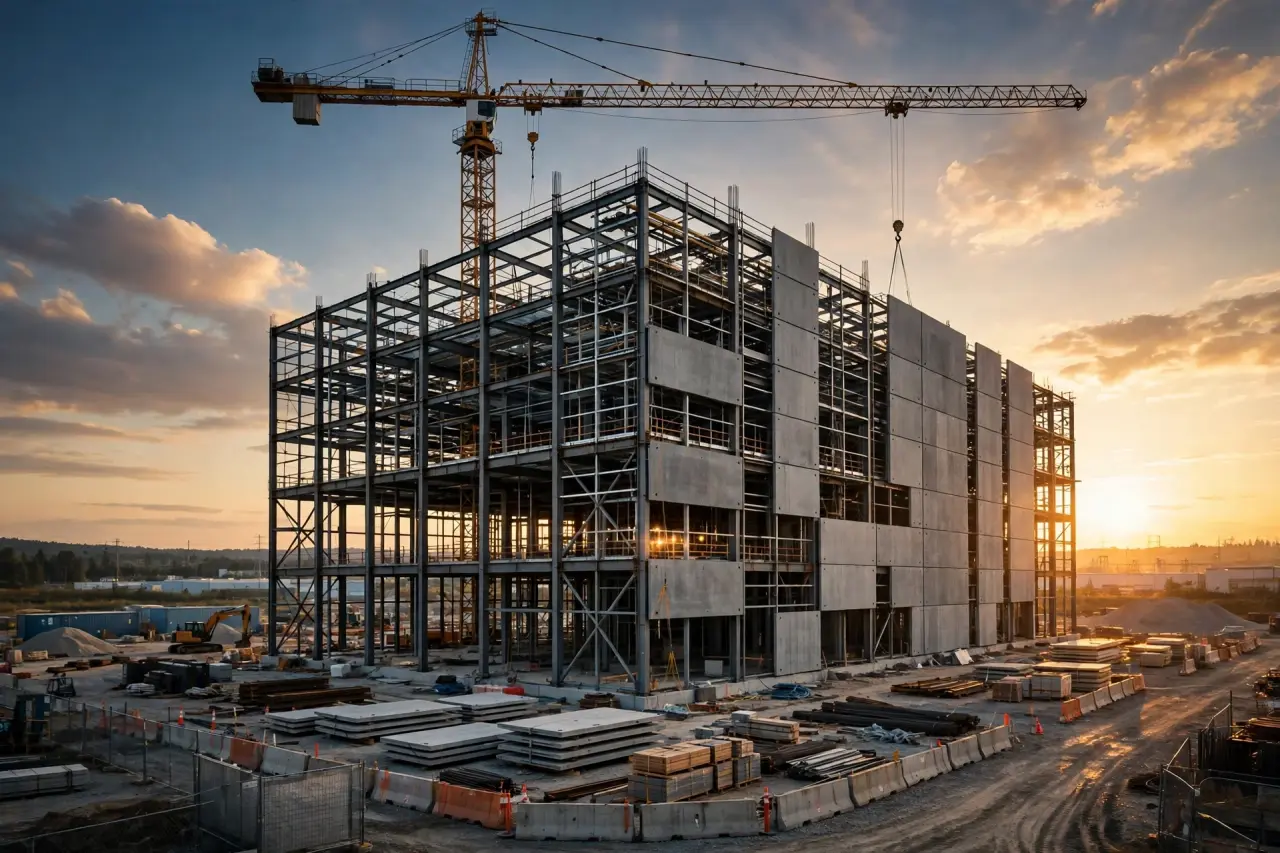
Start with the definitions, because the plant is the dividing line. In a build-to-suit, a developer acquires the land, secures power, builds to the tenant specification, and leases the finished facility to that single tenant. In a turnkey or build-to-suit delivery, the landlord delivers a fitted, commissioned hall and owns the plant, while the tenant brings racks, servers, GPUs, and network equipment. In a powered shell, the developer delivers the building without the plant: the envelope, the slab, and the structure sized for data hall loads, the utility feed or substation, fiber entries, and a secured perimeter, usually with generator yard pads and cooling pathways in place. The tenant installs, maintains, and owns the UPS systems, generators, cooling, electrical rooms, and racks. Wholesale colocation provides multi-megawatt turnkey suites in an operating facility, and the tenant brings only IT equipment. Retail colocation provides a cabinet or a cage, cross-connects, and service levels, and the tenant brings only IT equipment.
Size and duration decide most of it. One site-selection firm, BlackForge, frames it this way. Below a few megawatts, retail colocation or cloud usually wins. At tens of megawatts, wholesale colocation and build-to-suit come into play. At hundreds of megawatts, self-build and build-to-suit dominate. A load expected to run 15 years or more justifies ownership or a long lease, while a load that may change within five years argues for colocation or cloud. BlackForge lists build-to-suit or powered shell as the model for hyperscalers and AI companies, with speed and less tenant capital traded for a long single-tenant lease, and colocation as the model for enterprises, cloud, and network companies, with fast entry traded for less control and rising rents. It calls this a way to frame the decision, not a rule. Our view is that inference moves the build-to-suit threshold down, to builds as small as 1 MW.
Inference changes the density question. IndigiPC, a power and cooling vendor, puts AI inference and small GPU clusters at 15 to 40 kW per rack, AI training racks at 50 to 130 kW or more, and a traditional enterprise rack at 5 to 15 kW. DataBank uses a different scale: traditional data centers are designed for 5 to 8 kW per rack, while standard AI deployment needs 15 to 25 kW, high-density AI needs 30 to 50 kW, and extreme density needs 60 to 100 kW or more with liquid cooling. The point is that inference is denser than a traditional enterprise rack, but it is not training density. At the lower end of that range it can be air cooled with in-row containment. Sources differ on the upper end: DataBank puts the practical air limit near 25 kW per rack, and IndigiPC near 40 kW. Either way, it does not need a hyperscale training facility.
The commercial terms follow the same logic. A build-to-suit facility is constructed to a named tenant specification under a lease agreed before the building is finished. The developer funds and delivers it, and the tenant commits for a long term, usually 10 to 20 years, at rent that returns the developer cost plus a margin. Build-to-suit rent is set as a yield on the developer total delivered cost rather than a market rate, and the term is 10 to 20 years with renewal options. Typical terms are 10 to 20 years or more for a powered shell triple-net lease, 12 to 15 years base for turnkey or build-to-suit, 10 to 15 years for wholesale colocation, and 3 to 5 years for retail colocation. Signed lease to delivery is typically 18 to 30 months or more when power and entitlement are already secured, and far longer from raw land. Construction is typically 12 to 24 months, design and specification lock is 3 to 6 months, and commissioning is 2 to 4 months. Across primary North American markets, 80.4 percent of data center capacity under construction was already preleased in the first half of 2026, according to CBRE.
The named operators show the range. Prime Data Centers says its solutions range from a single data hall of 3 to 12 MW, through an entire data center of 20 MW or more, to a full campus of 100 MW or more. Prime says it delivers powered shells for custom infrastructure, build-to-suit environments for rapid deployment, and retrofits that transform legacy sites, and it offers joint ventures and sale-leaseback opportunities as well as more traditional leasing options. Sabey says it has more than 3.4 million square feet of mission-critical space and 380 MW of critical capacity, and that it designs, builds, and operates its purpose-built data centers itself.
Our position is simple. We build to suit, for AI inference, from 1 to 50 MW, wherever our tenants need capacity. The tenant gets a hall built to its specification, with the density and cooling its inference workload needs, and a landlord that owns the plant. If your workload is a few racks that may move in three years, take colocation. If it is an inference deployment of a megawatt or more that will run for a decade or more, build to suit is the model that fits, and that is the model we sell.
Sources
- CBRE, North America Data Center Trends H1 2026 (August 27, 2026): https://www.cbre.com/insights/books/north-america-data-center-trends-h1-2026
- GR1D, Powered Shell vs Turnkey vs Colocation Explained: https://gr1d.us/insights/powered-shell-vs-turnkey-vs-colocation
- BlackForge Data Centers, Build vs. Lease Data Center Capacity: How to Decide: https://www.blackforgedatacenters.com/guides/build-vs-lease-data-center-capacity
- Metro Colo Advisory, Build to Suit Data Center: Lease, Cost and Developers: https://metrocoloadvisory.com/build-to-suit-data-center/
- Prime Data Centers, About: https://primedatacenters.com/about/
- Sabey Data Centers, Expertise: https://sabeydatacenters.com/expertise
- DataBank, Colocation for AI Workloads: Power, Cooling and GPU Density Requirements Explained: https://www.databank.com/resources/blogs/colocation-for-ai-workloads-power-cooling-gpu-density-requirements-explained/
- IndigiPC, AI Data Centre Power and Cooling: https://www.indigipc.com.au/blogs/news/ai-data-centre-power-cooling-australia