
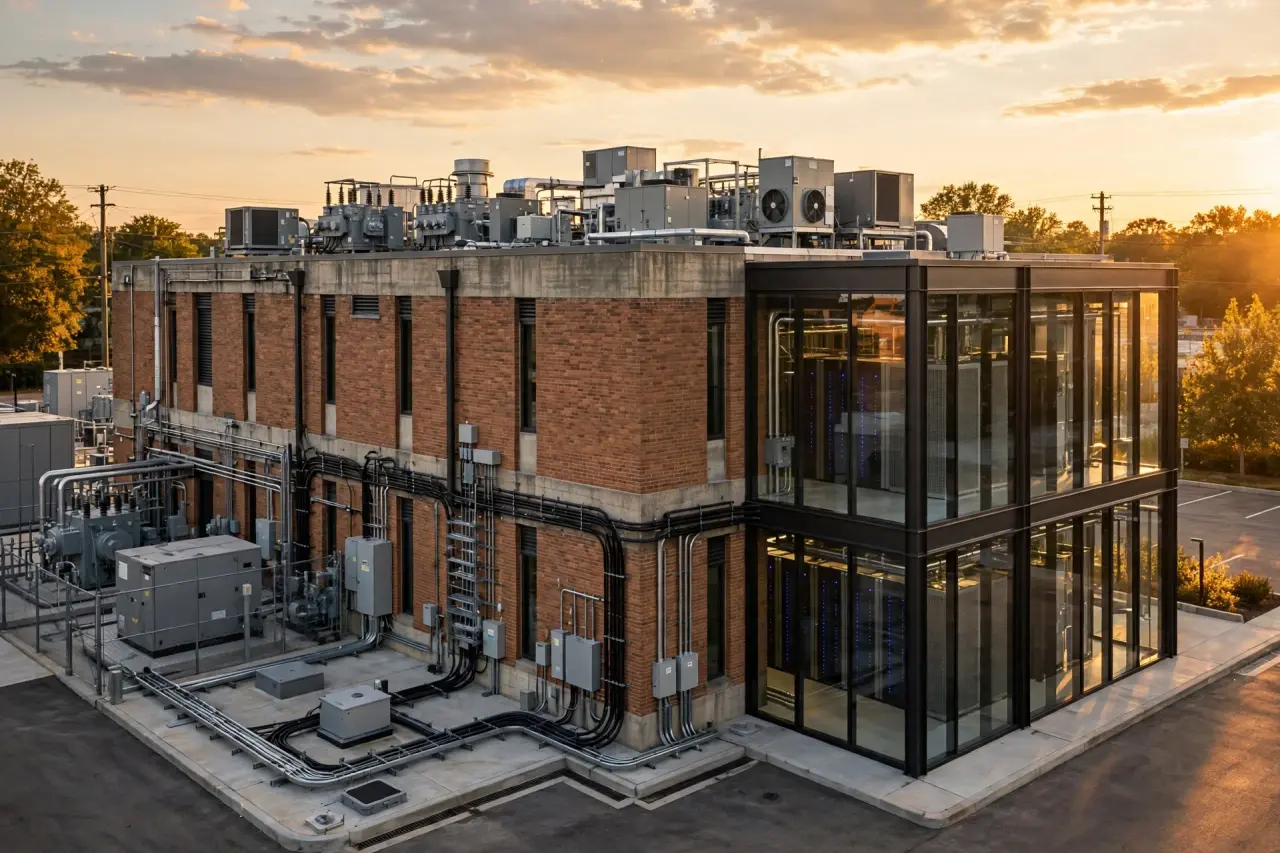
The buildings already exist. Thousands of central offices were built from the 1950s to the 1990s to switch phone calls. Carriers are retiring copper for fiber, and the buildings are increasingly underutilized. They were purpose-built for the network. They have the power, the fiber, and the structure. The fastest way to add edge capacity is not to break ground. It is to reuse a building that already has all three.
The clearest example is Ziply Fiber, a US telecom firm that launched a colocation business on its footprint of central offices. As Data Center Dynamics reported in June 2025, its colocation network totals more than 200 facilities across Washington, Oregon, Idaho, and Montana, based on central offices that in some cases date back to the 1960s. One site peaked at 98,000 phone lines. Today that building has capacity for 75 racks and about 500 kW of unused power, now that the switch has been decommissioned. Four or five sites have more than 1 MW available. Thirty or forty have between 500 kW and 1 MW. Hundreds have around 50 to 300 kW. Total capacity is, in the company’s words, “many, many megawatts.” The largest site is just under 100,000 square feet. The company owns about 400 buildings in all and puts the replacement value at “several billion dollars.”
These buildings were built to survive. Each site generally has an A-B electrical feed, in some cases A-B-C, along with several days of fuel storage. The company describes them as hardened telco fortresses with at least five days of fuel. In November 2022, a winter storm hit Snohomish County, just north of Seattle, leaving nearly 200,000 without power, with outages lasting five or six days in some cases. Nine or ten Ziply sites ran on generators the whole time. The company says it has looked at a couple of sites that could reach 5 to 10 MW without too much trouble, and that a number of sites already have megawatts of unused electrical service.
The same pattern is playing out on the other side of the Atlantic. BT, the UK carrier, is consolidating from about 5,600 network buildings to about 1,000 over the next decade, closing about 4,600 telephone exchanges as it shuts its copper network. Converting exchanges like these into colocation or edge data centers is not uncommon, though Data Center Dynamics notes that many sit in inner-city locations valuable for other uses, and that many exited sites have historically become housing or hotels.
The economics favor reuse. Data Center Invest, an investment firm that markets brownfield projects, puts typical conversion timelines at 12 to 24 months, which it says is often half the duration of greenfield development. It argues that reusing existing grid interconnections avoids long queue times, and that former central offices offer backbone fiber in urban cores suited to edge workloads. A central office typically already has its building permits, a grid connection, and fiber. A greenfield site starts from raw land and waits years for power. A central office starts from a building that has had power and fiber for decades.
There are honest limits, and they matter. Not every central office works. Modern AI racks need far more power per rack than legacy telco gear. Floor loads, cooling, and power distribution have to be checked site by site. Some buildings are too small or too expensive to retrofit, and upgrading electrical systems can eat into the cost savings. The work is diligence: addresses and power headroom in writing, site by site, before anything is promised. That is how we approach it.
Edge AI is a global provider, and the retrofit program is part of how we build. We are in discussions with a top 10 telecom provider on a partnership to retrofit several thousand of their sites into edge AI data centers, with details under NDA. We have several hundred sites identified, screened for power, fiber, and access, with 7 GW of power identified across them. The program converts existing telecom sites into AI inference capacity, where the building, the power, and the fiber are already there.
The telephone network spent decades building the edge. The buildings are still standing. The power and fiber are still in the ground. The fastest way to add edge capacity is to reuse them.
Sources
- Data Center Dynamics, Copper to colo: Ziply’s plan to repurpose its Central Offices (June 12, 2025): more than 200 facilities across Washington, Oregon, Idaho, and Montana; central offices dating to the 1960s; one site peaked at 98,000 phone lines, now 75 racks and about 500 kW of unused power; four or five sites with more than 1 MW available, 30 or 40 with 500 kW to 1 MW, hundreds with 50 to 300 kW; largest site just under 100,000 sq ft; about 400 buildings owned, replacement value “several billion dollars”; A-B electrical feeds and several days of fuel; November 2022 storm, nine or ten sites on generators while nearly 200,000 lost power; some sites could reach 5 to 10 MW. https://www.datacenterdynamics.com/en/analysis/copper-to-colo-ziplys-plan-to-repurpose-its-central-offices/
- Data Center Dynamics, BT’s landlord looms large over the UK’s telephone exchanges (December 4, 2025): BT consolidating from about 5,600 network buildings to about 1,000 over the next decade, closing about 4,600 exchanges; conversion to colocation or edge data centers is not uncommon, though many exited sites have become housing or hotels. https://www.datacenterdynamics.com/en/analysis/bts-landlord-looms-large-over-the-uks-telephone-exchanges/
- Data Center Invest, Brownfield Data Center Conversions: conversion timelines of 12 to 24 months, often half the duration of greenfield paths; reusing interconnections avoids long queue times and de-risks schedules; central offices provide backbone fiber in urban cores, ideal for edge workloads. https://www.datacenterinvest.com/investments/infrastructure-land/brownfield-assets